AI and Compliance Teams: Augmentation, Not Replacement
What the Moody's Data Actually Says About AI and Compliance Roles
A question that surfaces in almost every ESG and compliance team conversation right now is a variation of the same thing: will AI reduce headcount, or change it? Moody's 600-person global survey of risk and compliance professionals gives a cleaner answer than most vendor white papers do.
The short version: 96% of professionals expect their role to be affected by AI. Only 18% believe their role will be reduced or de-skilled. The remaining 82% expect their role to remain but to look materially different.
That split is worth sitting with. It is not a story about AI replacing compliance judgment. It is a story about AI absorbing the high-volume, low-signal work so that compliance teams can spend more time on the decisions that actually require human reasoning.
Three Ways the Compliance Role Is Changing
The Moody's report identifies three directions in which the compliance function is moving. They are consistent with what teams building AI-augmented compliance pipelines are already observing on the ground.
Strategic and advisory work. When AI is handling document triage, supplier screening, and regulatory change monitoring, the compliance professional has bandwidth for interpretation and strategy. That means reading across a regulatory change like EUDR's amended deadlines under Regulation (EU) 2025/2650, understanding which supplier segments are actually affected, and advising procurement accordingly — rather than manually updating a spreadsheet.
Exception handling and investigation. AI systems, including the multi-agent pipelines used in EUDR and CSRD compliance workflows, are well-suited to pattern detection at scale. They are not well-suited to deciding what a pattern means when the context is ambiguous. That final call — whether a geolocation discrepancy indicates fraud, data error, or a legitimate boundary dispute — stays with a human analyst. The AI narrows the field; the professional makes the call.
Governance and oversight of AI systems themselves. This is the shift that is most underestimated. In fintech specifically, 71% of surveyed professionals expect their role to become more supervisory in relation to AI models. For ESG and compliance teams, this means being accountable not just for the output of a compliance process, but for the model that generates it. That includes bias testing, output validation, and being able to explain to a regulator or auditor why the system produced a particular result.
What This Means for Teams Evaluating AI Compliance Infrastructure
If 82% of compliance professionals expect their roles to evolve rather than disappear, the practical implication is that the tools they adopt need to support that evolution — not try to replace it.
That distinction matters when evaluating compliance AI infrastructure. A system that produces a binary pass/fail on a due diligence check without surfacing the underlying evidence is not building analyst capability. It is creating a liability. Regulators, including those enforcing EUDR under Regulation (EU) 2023/1115, expect due diligence to be documented and defensible. "The AI said so" is not a defensible position.
The architecture that supports the Moody's model — where humans are elevated rather than bypassed — looks like this: AI handles data ingestion, geolocation verification, document parsing, and regulatory change monitoring. It flags exceptions with evidence. The compliance analyst reviews flagged cases, applies judgment, and closes them with a documented rationale. The audit trail captures both the AI output and the human decision.
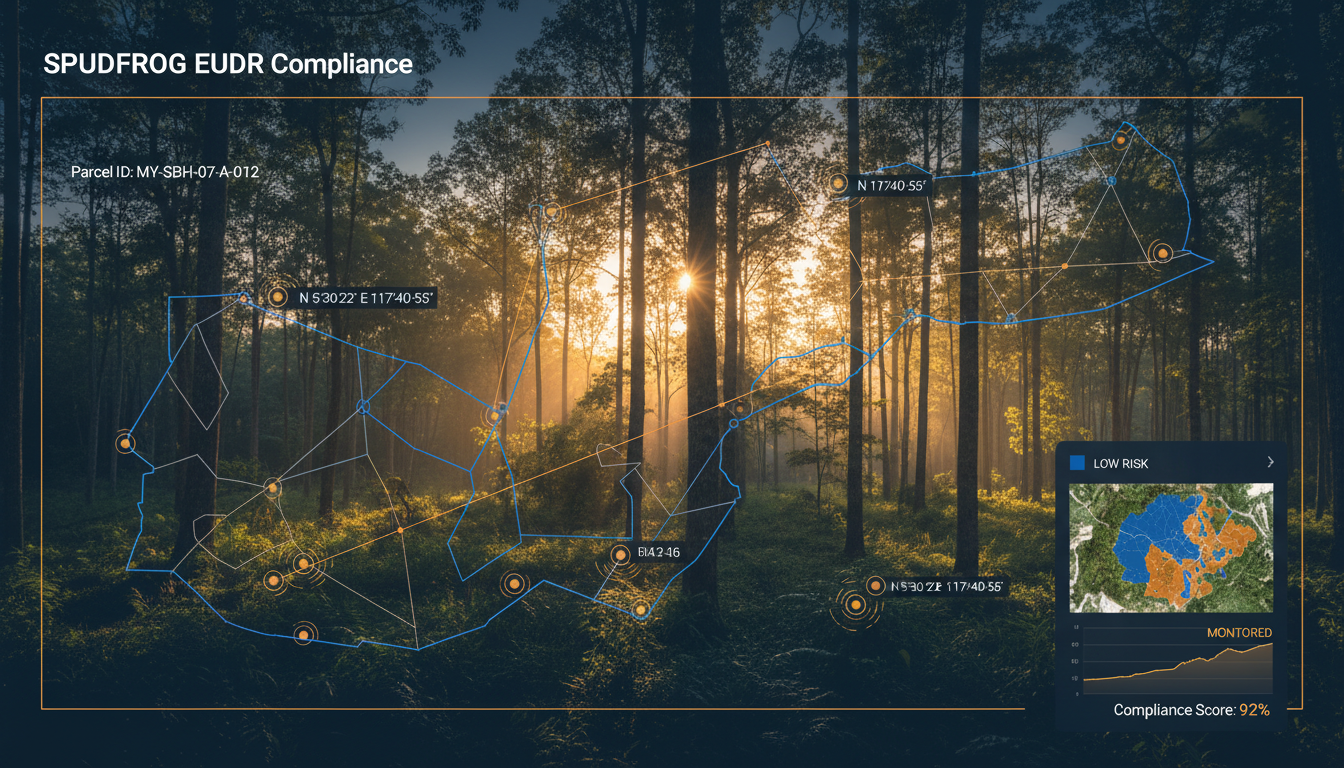
SpudFrog's GreenReg RAG Engine and Geospatial Intelligence Layer are built around this pattern. The RAG engine surfaces relevant regulatory text and flags changes against a client's supplier profile. The Geospatial Intelligence Layer cross-references harvesting plot coordinates against satellite-derived forest cover data from Sentinel-1/2, Landsat, and JAXA datasets — and returns a result with the evidence, not just a score. The compliance professional reviews, decides, and signs off.
Role Evolution by Function: A Practical Mapping
The table below maps the Moody's-identified role shifts to the specific compliance functions that ESG and EUDR teams manage today.
| Current task | AI-automated layer | Evolved human role |
|---|---|---|
| Manual supplier document review | Document ingestion and parsing pipeline | Exception review and escalation decisions |
| Monitoring regulatory change across jurisdictions | RAG-based regulatory change alerting | Strategic interpretation and internal advisory |
| Geolocation data collection and verification | Satellite-based plot verification (Sentinel-1/2, Landsat, JAXA) | Anomaly investigation and sign-off |
| Building due diligence statements for EUDR | Automated DDS drafting from verified supply chain data | Final review, attestation, and audit defence |
| Ad hoc CSRD data requests from procurement | Automated supplier data requests and gap flagging | Materiality judgement and disclosure strategy |
Adoption and Expectation Data from the Moody's Survey
The following table summarises the quantitative findings from the Moody's survey that are directly relevant to ESG and compliance platform decisions.
| Finding | Figure | Source |
|---|---|---|
| Professionals who expect AI to impact their role | 96% | Moody's global survey, 600 respondents |
| Professionals who expect role to evolve rather than be reduced | 82% | Moody's global survey, 600 respondents |
| Professionals who fear role reduction or de-skilling | 18% | Moody's global survey, 600 respondents |
| Fintech professionals expecting roles to become more supervisory | 71% | Moody's global survey, 600 respondents |
Frequently Asked Questions
If AI handles the volume work, does our compliance team need to grow? Not necessarily in headcount, but almost certainly in capability. The Moody's data suggests the function shifts toward oversight, investigation, and model governance. Teams that invest in upskilling analysts to work with AI outputs — reviewing evidence, validating results, closing exceptions with documented rationale — get more from the same headcount. Teams that simply pass AI outputs straight to audit without a human review layer are creating defensibility gaps.
How do we ensure AI-generated compliance outputs are audit-ready? The output alone is not what makes a finding audit-ready. The evidence chain is. A geolocation check that returns a verified result needs to show which satellite dataset was used, what the forest cover baseline was, and which regulation article the check was performed against. GreenReg and the Geospatial Intelligence Layer are designed to produce outputs with that evidence attached, not just a conclusion.
What does "governing AI" actually mean for a compliance team without ML engineers? In practice, it means three things: knowing what data the model was trained on and where it applies, having a process to flag when outputs look inconsistent with expectations, and being able to explain the system to an auditor in plain English. Compliance teams do not need to retrain models. They do need to understand what the system cannot do, and document that understanding as part of their due diligence process.
Does the 82% figure apply outside financial services? The Moody's survey was weighted toward financial services and fintech. The directional finding — that AI augments rather than replaces compliance judgment — is consistent with what sustainability and EUDR compliance teams are reporting. The specific tasks differ, but the pattern holds: AI absorbs the high-volume verification work; humans handle the ambiguous cases and the governance of the system itself.
Will regulators accept AI-generated due diligence? Regulators, including those enforcing EUDR, require that due diligence is documented, substantiated, and attributable to a responsible operator. AI can generate the documentation. The human compliance professional remains the accountable party who attests to it. That accountability structure is non-negotiable and is not changed by the 2025 amendments under Regulation (EU) 2025/2650.
If you are scoping AI compliance infrastructure and want to understand how GreenReg and the Geospatial Intelligence Layer fit into an existing compliance workflow, contact the SpudFrog team for a technical walkthrough.